Introduction: We Can Fix This
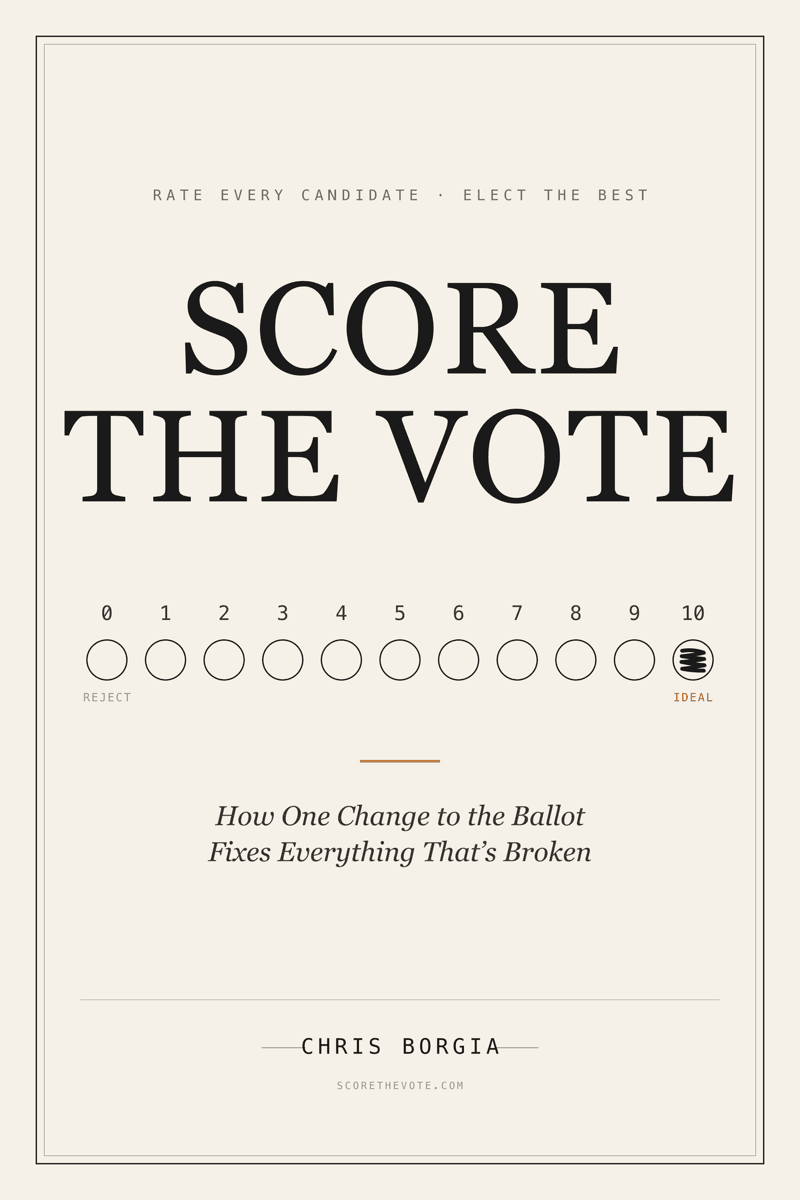
From Score the Vote by Chris Borgia
About 5 minutes to read.
You walk into a booth. You pick one name. You leave.
That’s it. That’s the entire conversation American democracy is willing to have with you. The most consequential act of citizenship — the one people marched and bled and died for — reduced to a single question: which one? Not how much. Not what you’d accept. Not whom you fear. Just: which one.
Now think about everything you carried into that booth. You didn’t show up with one opinion; you showed up with a dozen. A candidate you actually believed in. Another you could live with. A third you’d swallow hard and vote for if that’s what it took to keep the worst one out. Months of headlines and arguments and kitchen-table math, weighed into a real judgment about who should lead this country — and the ballot had room for almost none of it. Pick one. Say nothing about the rest. Leave.
Something is wrong with how we pick our leaders. The voting booth is where it starts.
It isn’t only an Election Day feeling. It’s every week in between: another subpar politician you never wanted advocating positions that don’t seem to align with the interests of America and all Americans, another visit to the voting booth where your strongest motive is voting against a candidate, not for one. You can feel all of that without being able to name what’s causing it. Nobody ever handed you a diagnosis, let alone a cure. That powerlessness isn’t a personal failing. It was built for you, by the people it protects.
That feeling isn’t cynicism, and it isn’t your imagination. It’s the rational response to three failures stacked one on top of another.
A failure of leadership — politicians who govern for the next primary instead of the next generation, who treat compromise as betrayal and the center as a place to be ambushed from both sides.
A failure of party — two machines that stopped trying to earn your vote a long time ago and learned to settle for frightening you away from the other side.
And underneath both, a failure of execution — a democracy that asks for your voice and then hands you an instrument too crude to carry it. One mark for one name. No way to say who you support completely (a 10), who you support only partway (a 6), or who you’re terrified of (a 0). Your entire political conscience, flattened into a single oval.
Here’s what that single mark really does: it concentrates power into exactly two parties — and hands them a monopoly they abuse as a matter of routine. Plurality voting doesn’t tolerate the two-party system so much as manufacture it. Every third choice becomes a spoiler, every independent a “wasted vote,” until a whole country’s worth of opinion collapses into two big tents.
And the people running those tents don’t answer to the country. They answer to whoever turns out for their primary — the most activist, most extreme slice of each party — and to the donors who bankroll them. For everyone else, the door is bolted from the inside. A new party can’t break in. An independent can’t survive the spoiler math. The advantage is structural, permanent, and entirely undeserved.
Notice that nothing in that diagnosis names a party. This isn’t a red book or a blue book. Whichever side of the aisle you call home — or if you walked away from both years ago — the machinery works against you the same way. Fixing it isn’t a left cause or a right cause. It’s maintenance.
We were promised self-government. What we got is the lesser of two evils, rebranded every four years as a moral emergency.
We deserve better than that — and not better personalities drawn from the same broken pipeline. Better rules. A ballot that rewards a candidate for representing all of us instead of inflaming just enough of us.
So here is the central conviction of this book: America is not short on leaders. It’s full of people who would govern honestly and represent all of us — people you’d be proud to vote for — and the ballot keeps them off the field before the race even starts. They don’t run, because under plurality voting a good candidate is just a spoiler.
Change the ballot, and you don’t have to go looking for better leaders. You simply unlock the door and let the ones we already have walk through it.
Stated plainly, before a single chart or citation: one change to how we vote — just one — would fundamentally change who wins. It would give us leaders who answer to the people, not to their party and not to themselves. That isn’t a slogan or a wish. It’s a mechanism — and by the end of this book you’ll understand exactly how it works, and why the math, the evidence, and the real-world results all point the same way.
Because the rot isn’t only in the people we elect. It’s in the math we use to elect them.
Democracy has a math problem — and you’ve already seen it. It’s the booth. It’s the single mark asked to stand in for your entire political worldview: every priority, every compromise, every nuance. One mark can’t carry all that. It never could.
The reform movement knows this. Ranked choice voting has grabbed headlines. STAR voting has its evangelists. But there’s a simpler, more powerful solution hiding in plain sight — one backed by decades of social choice theory, computer simulations, and real-world use.
It’s called score voting, and the whole idea fits on an index card: give every candidate a score from 0 to 10. Highest total wins.
That’s the entire system. No ranking, no rounds, no eliminations, no fine print. For the first time, the ballot can hold what you actually think — full support, partial support, flat rejection — about every name on it, all at once. Giving a 10 to the candidate you love takes nothing away from the one you could live with. The spoiler problem doesn’t get patched; it stops existing.
And it’s the best way to fix American elections.
This book makes that case. Not by dismissing other reforms — RCV and STAR are allies in the fight against plurality voting, and we’ll give them their due. But when you compare the systems head-to-head on the metrics that actually matter — voter satisfaction, resistance to strategy, simplicity, and mathematical optimality — score voting wins. Consistently.
But this isn’t just a book of arguments. It’s a toolkit.
By the time you’re done, you’ll have the talking points to explain score voting to anyone — your skeptical uncle at Thanksgiving, your coworker who thinks voting reform sounds complicated, your friend who’s given up on politics entirely. Clear, concise, impossible to dismiss.
You’ll also have a path forward. If you finish this book and want to do more than nod along — if you want to actually be part of the movement — we’ll show you exactly how. Where to plug in. What organizations are doing the work. How to bring score voting to your city, your county, your state.
And we’ll get concrete. Not “raise awareness” platitudes — real actions. Draft ballot language. Volunteer pipelines. Donation targets. Conversations to start. Campaigns to join.
The shape of the book is simple: first the disease, then the cure, then the fight. This book doesn’t end when you close it. It ends when your ballot changes.
Let’s start with the disease.
End of chapter 1.
Know someone who’s given up on politics? Send them this chapter.